7-Day Spiti Valley Road Trip from Delhi – Here’s Everything You Need to Know

|
Getting your Trinity Audio player ready...
|
I Wasn’t Prepared for How Much Spiti Valley Would Wreck Me – In the Best Way Possible
I have traveled to a lot of places across India. Goa for the beaches, Rajasthan for the forts, Kerala for the backwaters – the usual circuit. But nothing, absolutely nothing, prepared me for what Spiti Valley felt like.
I remember standing at the edge of Chandratal Lake at midnight, staring up at a sky so impossibly crowded with stars that I genuinely felt dizzy. The Milky Way wasn’t a smudge or a suggestion – it was a thick, blazing river of light stretched from one mountain to another. There was no sound except the occasional flutter of wind. No phone signal. No other light source for kilometres. Just me, a few fellow travellers, and the universe doing its thing.
That moment alone made the rough roads, the thin air, and the bone-chilling nights worth every bit of it.
If you’ve been sitting on the fence about a Spiti Valley trip, let me be the one to push you off it – gently, but firmly. In this post, I’m going to walk you through my complete 7-day road trip from Delhi covering Chitkul, Tabo, Kaza, Key Monastery, Hikkim, Komic, Langza, Chandratal Lake, and Manali. I’ll give you the full day-by-day breakdown, real costs, honest packing advice, and everything I wish I had known before I went.
Let’s go.
Quick Overview of My Spiti Valley Road Trip
Before I get into the details, here’s the bird’s-eye view of the trip:
| Detail | Info |
|---|---|
| Duration | 7 Days & 6 Nights (plus overnight travel each end) |
| Route | Delhi → Shimla → Chitkul → Tabo → Kaza → Chandratal Lake → Manali → Delhi |
| Trip Type | Group Road Trip |
| Best Time to Visit | May to July |
| Budget | Starting from ₹18,800 per person (3-sharing) |
| Meals | 7 Breakfasts + 6 Dinners (Veg, included) |
| Stays | Homestays, Hotel & Camps |
| Who It’s Perfect For | Ages 18–35, first-time Himalayan travellers, adventure lovers |
The Full Day-by-Day Itinerary — From My Own Experience
Day 00 – Overnight Bus from Delhi to Shimla
My Spiti adventure technically started the night before Day 1, at ISBT Kashmiri Gate in Delhi. The departure was at 8:00 PM sharp in a semi-sleeper AC Volvo bus, and honestly, it was a perfectly comfortable way to cover the Delhi-to-Shimla leg overnight.
I remember sitting by the window as the bus left the city – the chaos of Delhi slowly dissolving into the dark quiet of the highway – and feeling that particular kind of excitement that only exists at the start of a big trip. I barely slept. Not because the bus was uncomfortable, but because I was too busy staring at the road ahead.
My advice: Keep a light jacket in your cabin bag. The AC can get quite cold overnight. And if you’re someone who struggles to sleep sitting up, carry a neck pillow – it makes a real difference.
Day 01 – Shimla to Chitkul: The Last Village of India
We arrived in Shimla early in the morning, had breakfast, and the road trip officially began. And what a way to begin.
The drive from Shimla to Chitkul is one I would happily do again just for the scenery. We drove past Kufri and Narkanda on the Indo-Tibetan Highway, through dense forests and apple orchards, before the road started narrowing dramatically as we entered Kinnaur. Crossing the Kinnaur Gate – a striking stone archway that marks the entry into Kinnaur Valley – felt like crossing into another world.
The Kinnaur Kailash Range started appearing on one side and the Sangla Valley opened up on the other, with the turquoise Baspa River cutting through far below. I had my face pressed against the window for most of this stretch like an excited kid.
By evening, we reached Chitkul – the last inhabited village on the Indo-Tibetan border road, sitting at roughly 3,450 metres. I stepped out of the Tempo Traveller, took a deep breath of that cold, clean mountain air, and just stood there for a moment.
Chitkul is small. You can walk through the entire village in fifteen minutes. But it has this weight to it – ancient wooden Kinnauri houses, prayer flags strung between rooftops, snow peaks surrounding you on all sides, and the knowledge that beyond this point, there is no more India. It’s the kind of place that puts your everyday problems into immediate perspective.
We stayed at a local homestay, had a warm dinner with our hosts, and I slept better than I had in months.
Overnight stay: Chitkul Homestay, Meals: Breakfast & Dinner included
My tips for Chitkul:
- Wake up early the next morning just to see the valley in golden hour light – it’s stunning
- visit the ancient Mathi temple and the ITBP last post for a photo you’ll never stop being proud of
- The nights are cold even in summer – layer up
Day 02 – Chitkul to Tabo via Khab Sangam & Nako Lake
Day 2 was long. Really long. But every hour of driving was worth it.
We left Chitkul after breakfast and started the drive towards Tabo, tracing a route that took us close to the India–Tibet border. The landscape here is starkly beautiful – treeless, rocky, and vast in a way that feels almost aggressive. No soft hills here. Just sharp mountains and the occasional river far below.
Our first major stop was Khab Sangam, and I genuinely did not expect it to hit me the way it did. This is the point where the Spiti River merges with the Sutlej River – and the Sutlej itself originates from Mansarovar Lake in Tibet and has travelled hundreds of kilometres to get here. Standing on the bridge above the confluence and looking down at two rivers – one silty brown, one a deeper green – merging into each other against a backdrop of bare, ancient mountains felt deeply moving for reasons I still can’t fully articulate.
Later in the drive, we stopped at Nako Lake, a small sacred lake at about 3,625 metres next to the village of Nako. When I visited, parts of it were still partially frozen, and the reflections of the surrounding peaks on the unfrozen sections were extraordinary. We sat here for a while, had some chai from a tiny stall nearby, and just breathed.
By evening we arrived at Tabo, and I remember being surprised by how peaceful and quiet it was. No big hotels, no tourist chaos – just a small, ancient village with a thousand-year-old monastery waiting to be explored the next morning.
Overnight stay: Tabo Homestay, Meals: Breakfast & Dinner included
Day 03 – Tabo Monastery, Dhankar Monastery & Arriving at Kaza
If I had to pick one day from the entire trip that moved me the most intellectually and spiritually, it would be Day 3.
We started the morning with a visit to Tabo Monastery, and I was completely unprepared for how extraordinary it is. Founded in 996 AD, this monastery has been standing for over 1,000 years. Think about that for a moment. While kingdoms rose and fell, while continents shifted their power, this collection of mud-walled temples in a remote Himalayan valley quietly continued existing.
The ancient wall paintings inside are unlike anything I have seen anywhere in India – faded in places, but still vivid with intricate detail. The mud statues have a stillness about them that feels almost alive. And standing in the open courtyard and looking up at that enormous open sky above – it’s the closest I’ve come to understanding why people call certain places sacred.
After Tabo, we drove to Dhankar Monastery, which is possibly the most dramatically situated monastery in all of Himachal Pradesh. It sits on a narrow cliff spur with the Spiti River and Pin River converging far below it, and the views from up here are staggering. The monastery is old, slightly crumbling, and absolutely magnetic.
We reached Kaza by mid-afternoon – the main town of Spiti Valley. After days of tiny villages, Kaza felt like a metropolis (it isn’t; it’s a small Himalayan town, but everything’s relative). I spent the evening browsing the market, picking up a few handcrafted pieces, and sitting in one of Kaza’s surprisingly good cafés with a bowl of thukpa that I’m still thinking about.
Overnight stay: Kaza Homestay, Meals: Breakfast & Dinner included
Day 04 – Key Monastery, World’s Highest Post Office, Komic & Langza
This was the sightseeing day, and it absolutely delivered.
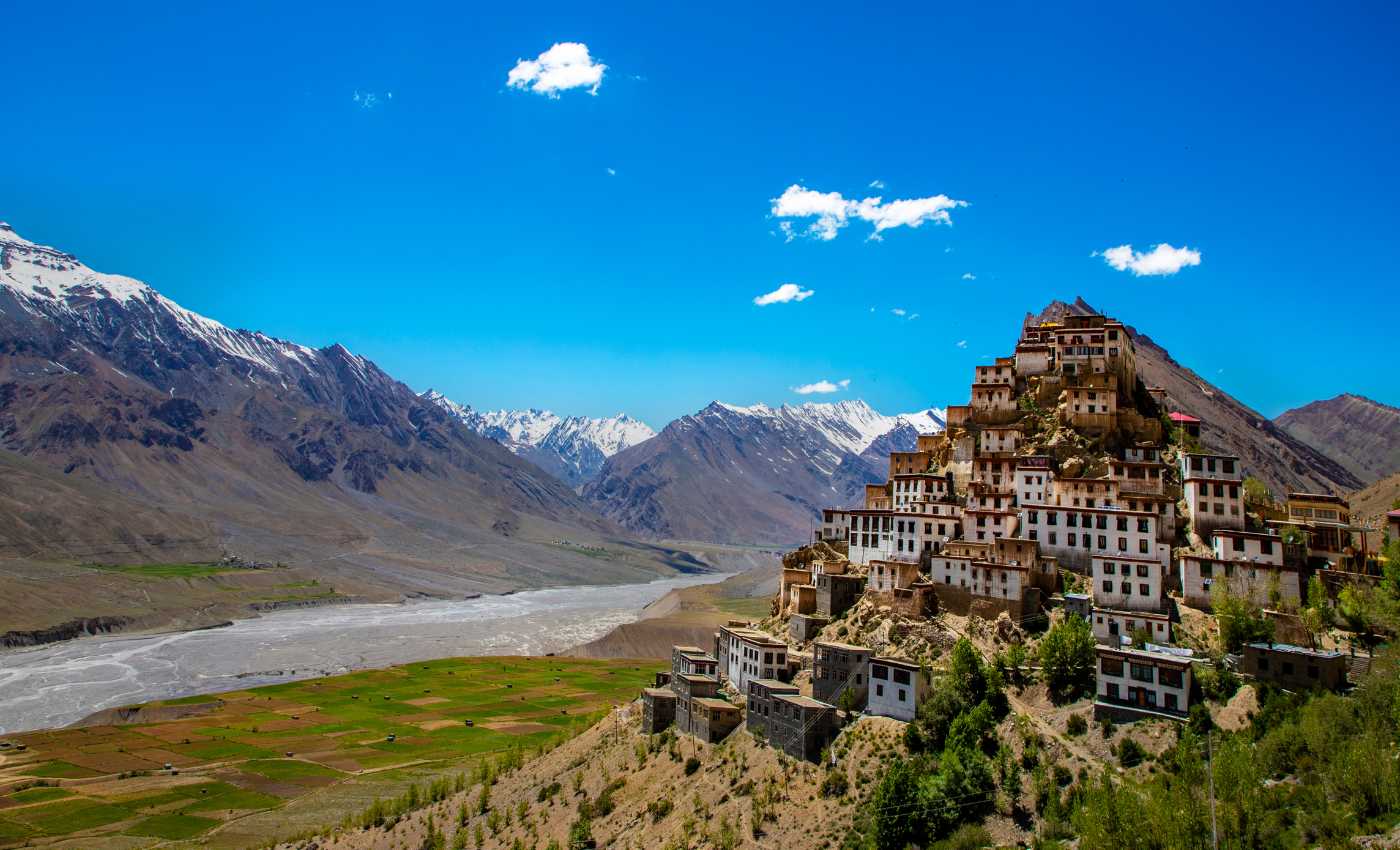
We started at Key Monastery – the iconic hilltop monastery that you’ve probably seen in every Spiti Valley travel photo ever taken. It’s larger than it looks in pictures, and the view of the Spiti Valley from its rooftop is the kind that makes you feel like you’re standing at the top of the world. The monastery is still fully active — young monks in maroon robes go about their routines around you, and the sound of chanting echoes through the corridors. I spent probably longer here than I should have.
Next, we drove up to Hikkim to visit the World’s Highest Post Office at 14,400 feet. I sent a postcard to my parents from here. It felt like a small, silly, perfect thing to do. The stamps they sell here are collector’s items – I bought a few extra.
From Hikkim, we went to Komic, the World’s Highest Motorable Village at approximately 15,050 feet above sea level. I’ll be honest — I felt slightly dizzy here just walking around. The altitude is real. But so is the surreal beauty of the place. It looks like a village from another planet. The Komic Gompa sits here quietly, and the views across the valley from this height are beyond words.
Our last stop was Langza, and this one surprised me the most. Yes, there is a giant, beautiful Buddha statue overlooking the valley (breathtaking), but what blew my mind was being able to pick up actual marine fossils embedded in the rocks on the hillside. Ammonite fossils – ancient sea creatures – at 14,000 feet in the Himalayas. A reminder that these mountains were once a seabed. Standing there with a fossil in my hand and a Buddha statue behind me felt like holding two very different concepts of time simultaneously.
We returned to Kaza by evening.
Overnight stay: Kaza Homestay, Meals: Breakfast & Dinner included
Day 05 – Chicham Bridge & Chandratal Lake: The Day I’ll Never Forget
I’m going to be completely honest with you: this was the single best day of the entire trip.
We started the morning at Chicham Bridge – Asia’s highest suspension bridge – and the first time I looked down through the bridge’s grating at the gorge hundreds of metres below, my stomach genuinely lurched. Walking across it while the wind pushes you sideways and you can see straight down into the abyss is the kind of thing that reminds you you’re alive. Several people in our group refused to look down. I, on the other hand, could not look away.
Then came Chandratal.
The drive to Chandratal Lake takes you through Kunzum Pass and into increasingly dramatic high-altitude terrain. And then suddenly, around a bend, it appears – Chandratal Lake, also called the Moon Lake. Crescent-shaped. Sitting at around 4,250 metres. Surrounded by bare mountains and patches of snow. And the water… the water is this impossible, almost artificial-looking shade of turquoise blue-green that shifts as you move around the lake.
I stood at the edge of it and genuinely did not move for a long time. Some of the people in our group had tears in their eyes. I completely understood why.
We set up camp nearby, and as the evening settled in and the stars began to appear, it quickly became the best stargazing experience of my life. The Milky Way here isn’t a rumour – it’s a blazing highway of light cutting directly overhead. I stayed outside until 2 AM and I regret absolutely nothing.
Important note from my experience: Chandratal Lake typically opens by late May depending on snowmelt and road conditions. If the road is blocked, the route continues via Kalpa and Shimla instead – still beautiful, just different.
Overnight stay: Chandratal Camps (Swiss tents), Meals: Breakfast & Dinner included
Day 06 – Chandratal to Manali via the Atal Tunnel
I woke up before sunrise on Day 6 and walked out of my tent in the dark. Chandratal at pre-dawn is a different experience entirely – the lake perfectly still, mist rising off the surface, the mountains beginning to glow faintly at their edges. If you do this trip, please wake up early this morning. Please.
After breakfast, we started the long drive towards Manali via Chhatru. This stretch of road is genuinely adventurous – water crossings, rough patches, sections where the road practically disappears. Our driver was clearly experienced and completely unfazed; I found the whole thing thrilling.
The landmark of the day was the Atal Tunnel – 9 kilometres long, the world’s longest highway tunnel above 10,000 feet. The tunnel connects Lahaul Valley to Manali, and driving through it is one of those experiences that sounds mundane until it actually happens to you. You enter on one side into a high-altitude, almost lunar landscape and emerge on the other into the lush green Kullu Valley. It happens in nine kilometres. It genuinely feels like a magic trick.
By evening we were in Manali – hot showers, proper beds, restaurant food – and the contrast after days up in the mountains was gloriously jarring.
Overnight stay: Manali Hotel, Meals: Breakfast & Dinner included
Day 07 – Manali Sightseeing & The Overnight Bus Back to Delhi
The last full day. It’s always bittersweet.
We started with adventure activities – I went paragliding, which after everything else felt like a perfectly logical way to spend a morning in Manali. River rafting is also available and equally excellent if that’s your thing.
Then came the Hadimba Devi Temple – a stunning ancient wooden temple tucked into a cedar deodar forest, built in 1553 AD. The intricate wood carvings on the exterior are remarkable. It has a completely different aesthetic from the Tibetan Buddhist monasteries we’d been visiting all week, and yet it felt like the perfect final sacred space to visit.
I spent the afternoon at Mall Road and Old Manali – shopping for Tibetan jewellery and local shawls, eating at a rooftop café, and trying to mentally prepare for returning to real life. It didn’t fully work, but the food helped.
In the evening, we boarded the Volvo bus back to Delhi. I sat by the window, watched Manali disappear behind a mountain curve, and sat with the quiet satisfaction of a trip fully lived.
Day 08: Arrived back in Delhi early morning. Real life resumed. But something had shifted – and I mean that in the best possible way.
Meals: Breakfast included
What the Trip Costs – Complete Breakdown
Here’s exactly what I paid, laid out clearly:
| Sharing Type | Discounted Price | Regular Price |
|---|---|---|
| 3 Sharing per Room | ₹18,800 per person | |
| 2 Sharing per Room | ₹20,800 per person |
What’s included in the price:
- Volvo semi-sleeper AC bus (Delhi → Shimla and Manali → Delhi)
- All internal travel in Spiti by Tempo Traveller
- 6 nights accommodation in homestays, hotel, and camps
- 7 breakfasts + 6 dinners (veg)
- All sightseeing and permits
- Dedicated trip leader throughout
- First aid kit with oximeter
- Oxygen cylinder for emergencies
- 24×7 support
My personal spending beyond the package came to roughly ₹3,500 – covering lunches, a few café stops in Kaza and Manali, some shopping, and paragliding in Manali. So budget around ₹22,000–₹24,000 all-in for a very comfortable experience.
Why I’d Recommend Going with a Group (Especially Your First Time)
I know some of you reading this prefer independent travel. I usually do too. But for Spiti Valley, especially on a first visit, a well-organised group trip genuinely makes sense, and here’s why I think so:
The altitude is real and it doesn’t care how fit you are. Having a trip leader carrying an oximeter to monitor everyone’s oxygen levels – and an actual oxygen cylinder for emergencies – is not just a nice extra. It’s real safety infrastructure that I was quietly grateful for at 15,000 feet in Komic.
The roads need experienced drivers. Sections near Chandratal especially are not routes you want to be figuring out solo. Offroad patches, water crossings, sections that barely qualify as roads – experience matters here.
Logistics in Spiti are genuinely complex. Permits for restricted zones, stays in remote areas with no reliable online booking, knowing when seasonal roads are likely to open – a properly run group takes all of this off your plate entirely.
And the people make the trip extraordinary. I went not knowing a single person in my group. I came back with friends I’m still in touch with. Seven days of shared experiences at altitude does something to people – it accelerates friendship and creates bonds that are surprisingly real.
My Honest Packing List — Things I Learned the Hard Way
Clothing (this is where most people go wrong):
- Thermal innerwear, top and bottom – non-negotiable even in May and June
- At least 2 warm mid-layers (fleece or a light down jacket)
- A windproof, waterproof outer shell
- Comfortable trekking trousers – avoid jeans, they’re heavy and take forever to dry
- Warm socks, at least 4–5 pairs
- Warm hat and gloves absolutely essential at Chandratal and Komic
Sun protection (I underestimated this):
- Sunscreen SPF 50+ – the UV radiation at altitude is significantly stronger; I got burnt on Day 1 before I took it seriously
- Good UV-protective sunglasses – essential, not a fashion accessory
Practical gear:
- A sturdy power bank – charging points are scarce in the mountains
- Extra camera or phone batteries if you’re shooting a lot
- Basic personal first aid supplies
Money:
- Carry sufficient cash before leaving Shimla. ATMs beyond Shimla are unreliable or non-existent. I’d recommend at least ₹5,000–₹6,000 in cash for personal expenses.
Tech:
- Download offline Google Maps for the entire route before you leave Delhi
- Download any music, podcasts, or shows in advance – you’ll be largely offline for most of the trip (which, honestly, is a gift)
Answers to Every Question I Had Before Going
Is Spiti Valley doable for someone who’s never done high altitude before?
Yes – if the itinerary is designed to acclimatise you gradually (this one is). I had never been above 4,000 metres before this trip. I was fine, with some awareness and good hydration. Don’t let the altitude put you off.
What is altitude sickness and how do I avoid it?
Altitude sickness (AMS) causes headaches, nausea, fatigue, and breathlessness. The best prevention: drink a lot of water, avoid alcohol for the first couple of days, move slowly and don’t over-exert, and follow the gradual ascent that this itinerary is built around. If symptoms are severe, the right call is always to descend.
When does Chandratal Lake open?
Usually by late May, depending on snowfall and road conditions. This varies year to year.
Do I need permits for Spiti?
Yes, Inner Line Permits are required for certain zones. These are handled as part of the trip.
Is vegetarian food available throughout?
Yes. The included meals are vegetarian, and local homestays and dhabas across the route serve simple, wholesome veg food. Options get more limited in remote areas, but I was never without a meal.
What’s the phone signal like?
Mostly absent. BSNL has coverage in a few areas. Most other networks don’t work for large parts of the route. I found this to be one of the best things about the trip – lean into it.
Should You Go? My Honest Answer
Yes. Without hesitation, yes.
Spiti is not a trip that coddles you. The roads are rough. The air is thin. The nights can be genuinely cold. You’ll be without phone signal for days at a stretch. And there are no luxury hotels waiting at the end of each day’s drive.
But it gives you something that almost no other destination in India does – a complete reset. Seven days in Spiti will recalibrate something in you. The landscapes will humble you. The monasteries will quiet you. Chandratal at midnight will absolutely undo you.
I came back from this trip lighter in a way that had nothing to do with luggage. If you’re between 18 and 35 and you have even a small appetite for adventure – and honestly, even if you think you don’t – this trip will show you something about yourself that you’ll be glad to know.
Don’t wait for the perfect time. Book the seat. The mountains will handle the rest.