Jagannath Temple, Puri: A Complete 2026 Guide to Myths, Rituals, and the Rath Yatra

|
Getting your Trinity Audio player ready...
|
Disclaimer: The information provided in this blog is based on personal experiences, research, and data available as of November 2025. Travel conditions, prices, timings, permits, and rules (especially for temples, national parks, and festivals like Rath Yatra) can change without notice.
Main Awara is not responsible for any inconvenience, loss, or damage caused by relying on this content. Always check official sources (Odisha Tourism, temple websites, local authorities) before planning your trip. Non-Hindus are not permitted inside Jagannath Temple, Puri – please respect local customs.
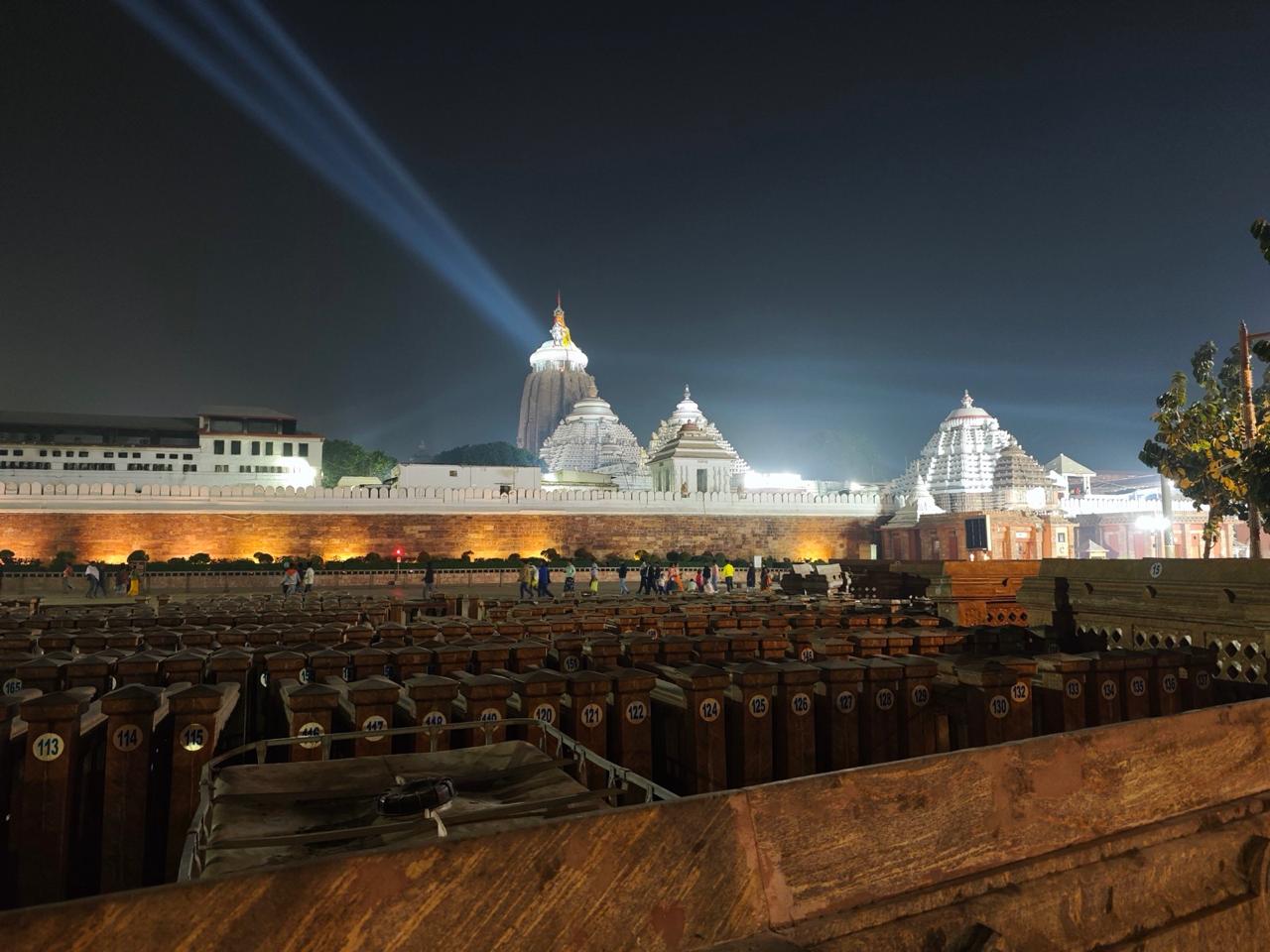
On Odisha’s coastline, where the Bay of Bengal meets centuries of unbroken ritual, the Jagannath Temple in Puri remains one of India’s most powerful pilgrimage sites. It is one of the four Char Dham – the great pilgrimage circuit of Hinduism, alongside Badrinath, Dwarka, and Rameswaram – and home to Lord Jagannath (a form of Vishnu/Krishna), worshipped together with his brother Balabhadra and sister Subhadra. The temple has also just been through its biggest physical transformation in decades, so a lot of practical details have changed even for people who visited a few years ago. Here’s an updated, detailed guide for 2026.
The Legend Behind the Deities
The origin story is one of Odisha’s most enduring pieces of folklore. King Indradyumna is said to have dreamed of a sacred log drifting ashore at Puri – wood believed to carry the presence of Vishnu himself. A divine craftsman (often identified as Vishwakarma) agreed to carve the idols on the condition he would not be disturbed, but an impatient queen broke his solitude too soon. He vanished, leaving the images of Jagannath, Balabhadra, and Subhadra unfinished: stub-like arms, wide circular eyes, no clearly carved legs. Rather than being seen as a flaw, this incompleteness is central to the temple’s theology – the deities are read as a symbol of the eternally unfinished, ever-becoming nature of existence itself.
Historians trace the current temple structure to the 12th century, built under the Eastern Ganga dynasty, though worship at the site is generally understood to predate the building by a long stretch. What makes Jagannath worship distinctive is how thoroughly it fuses older tribal and folk traditions with mainstream Vaishnavism — one reason the temple has long been described as a place where caste and social boundaries matter less than almost anywhere else in Hindu ritual life.
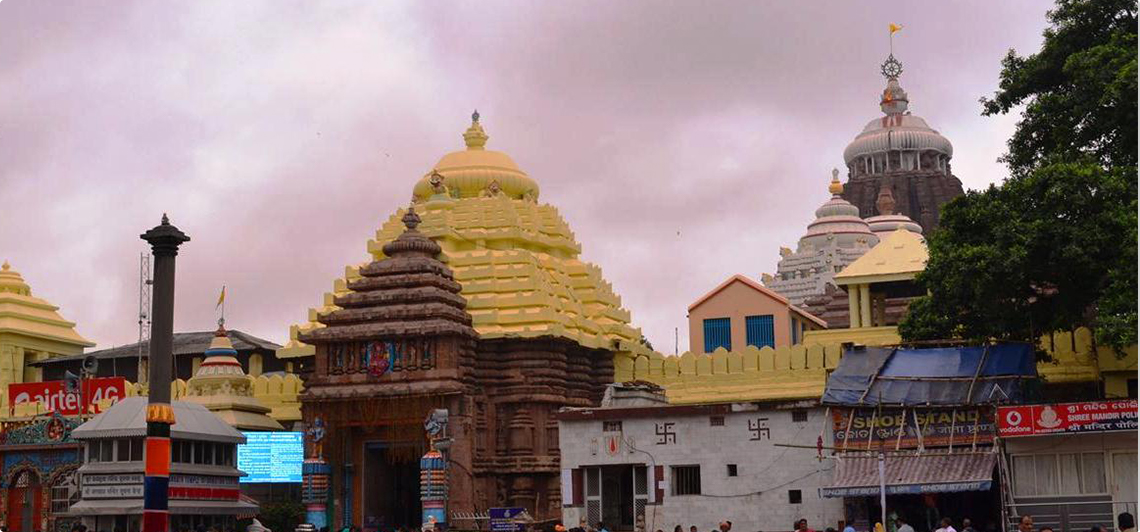
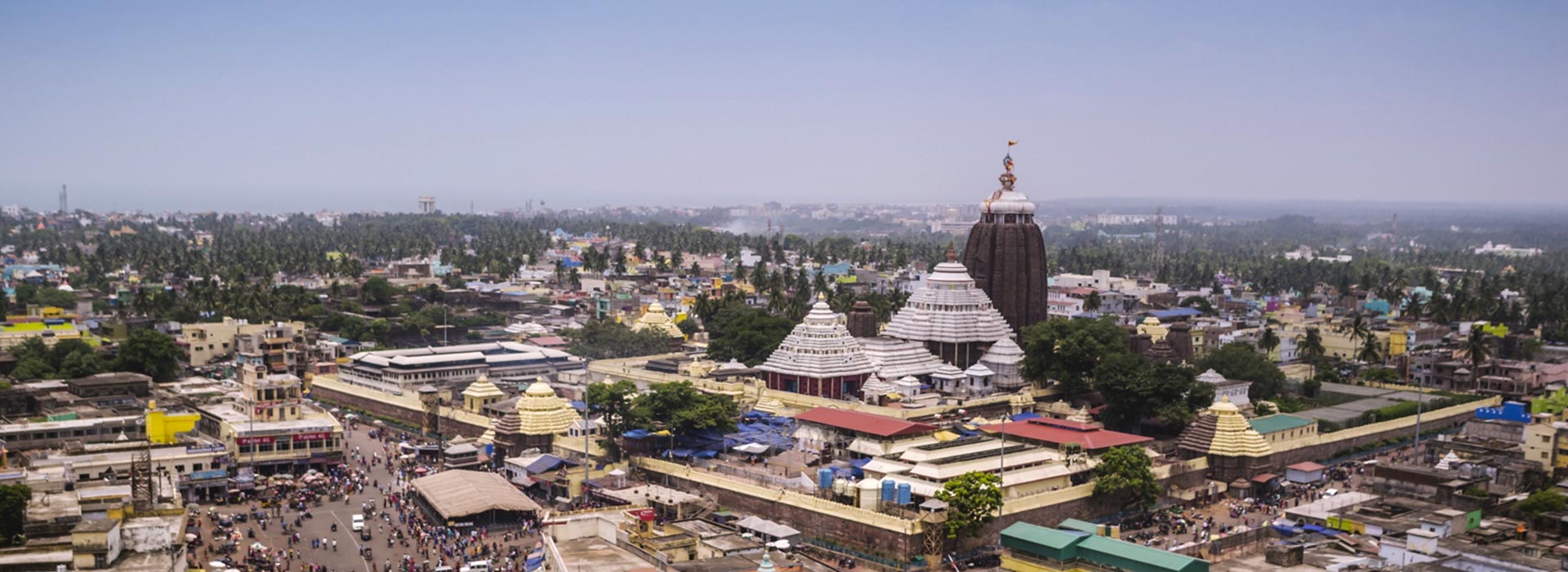
A quick note on the architecture: the main tower (vimana) rises about 65 meters in the classic Kalinga style, with a curvilinear spire capped by the Nilachakra — the sacred wheel at the summit, over 3.5 meters across, believed to represent the Sudarshana Chakra and considered auspicious enough that pilgrims try to catch a glimpse of its shadow. The complex sprawls across roughly 400,000 square feet and includes dozens of subsidiary shrines, kitchens, and mutts (monastic residences) within its outer wall, the Meghanad Pacheri.
Photography inside the sanctum is not permitted, and — a rule visitors should know before travelling — entry to the temple is restricted to Hindus. Non-Hindu visitors can still experience a great deal from just outside: the Raghunandan Library rooftop across from the main Singha Dwara (Lion Gate) gives a clear elevated view of the tower and the Neelachakra, and is free to visit.
The Daily Ritual Cycle
Few temples in India run a ritual calendar as dense as this one — the deities go through roughly three dozen distinct ceremonial baths and rites (snanas) across the year, on top of a strict daily schedule. Broadly, the day unfolds like this:
- Mangala Aarti, around 5:00–5:30 AM – the temple’s opening ritual, when the deities are woken and anointed.
- Sakala Dhupa, roughly 9:00–10:00 AM – the morning bhog (food offering); general darshan is usually paused during this window.
- Midday offerings – a further round of bhog, part of the famous 56-dish (chhappan bhog) tradition, prepared in the temple’s enormous kitchen said to be one of the largest in the world.
- Sandhya Aarti, around 6:00 PM – the evening lamp ceremony, typically the most crowded darshan of the day.
- Badasinghara/Badashringara, around 9:30–10:30 PM – the final, most elaborately decorated appearance of the deities before they retire for the night, and often the calmest window for darshan since crowds thin out by then.
A useful thing to know that catches a lot of first-time visitors off guard: darshan is not continuous throughout opening hours. The inner sanctum closes for roughly 30–60 minutes around each bhog offering, even for Hindu pilgrims already inside the complex. If your plan is a quick visit, aim for early morning (5:30–7:30 AM on a weekday) or the late-evening Badasinghara slot rather than midday.
On cost: general darshan (Sarva Darshan) is free. There is currently no official VIP or fast-track ticket sold by the temple administration for routine daily darshan – be cautious of touts or third-party sites claiming otherwise. On certain mornings a modest fee applies for Paramanik Darshan, which allows a closer approach to the Ratna Singhasana (jewelled throne platform), managed on-site by temple staff rather than booked online.
| Ritual Time | Highlight | Best For |
|---|---|---|
| Dawn (4-6 AM) | Awakening & first aarti | Spiritual seekers |
| Midday (11 AM-2 PM) | Bhog preparation | Food lovers |
| Dusk (6-8 PM) | Evening worship & lights | Photographers |
What’s Changed: The Heritage Corridor
The single biggest update for returning visitors is the Shree Mandir Parikrama (also called the Shree Jagannath Heritage Corridor) – a roughly 75-metre-wide corridor built entirely around the temple’s outer wall, similar in spirit to the Kashi Vishwanath Corridor in Varanasi. Construction began in 2021 as part of Odisha’s broader ABADHA redevelopment scheme, and the project was inaugurated in January 2024 at a cost reported in the hundreds of crores of rupees. It gives pilgrims an open, unobstructed view of the temple’s boundary wall and the Nilachakra, adds a reception centre, paved and shaded walking areas, drinking water points, and improved security infrastructure, and has visibly changed how the immediate temple precinct looks and feels compared to a few years ago.
Alongside the corridor, the temple administration has also introduced a one-way darshan flow during high-footfall periods (major holidays, weekends around festivals): pilgrims enter through the Singha Dwara and exit through one of the temple’s other three gates, with barricading and a heavier police presence to manage crowds.
Rath Yatra: The World’s Largest Chariot Festival
The temple’s best-known event is the Rath Yatra, or Chariot Festival — an event so old it’s referenced across the Skanda, Brahma, and Narada Puranas, and one that, remarkably, has continued every single year without interruption despite invasions, political upheaval, and, more recently, a pandemic. In 2026, Rath Yatra falls on July 16, with the return procession, Bahuda Yatra, following on July 24. During the festival, the three deities leave the sanctum and travel roughly 3 kilometres down the Grand Road (Bada Danda) to the Gundicha Temple, where they stay for about a week before returning — and this is the one time in the year when the deities can be seen by absolutely everyone, Hindu and non-Hindu alike.
A few details that are genuinely worth knowing rather than the usual generic festival trivia:
- The chariots are rebuilt from scratch every year, using specified types of wood, with construction beginning around Akshaya Tritiya (April–May) and no metal nails used in the frames. Lord Jagannath’s chariot, Nandighosha, stands roughly 45 feet tall and typically runs on 16 wheels, dressed in red and yellow canopies; Balabhadra’s Taladhwaja and Subhadra’s Darpadalana (or Devadalana) follow, each with their own wheel count, colour scheme, and dedicated pulling teams.
- The hereditary servitor communities of Puri – including the Daitapatis and Suaras – carry out every stage of the ritual in precise, generations-old detail, which is part of why the festival is often described as essentially unchanged in character for over a thousand years.
- On the return journey, the deities pause briefly at the Mausi Maa Temple (literally, the aunt’s abode) for an offering of Poda Pitha, a baked rice-and-lentil cake said to be a personal favourite of the Lord.
- Mahatma Gandhi is often said to have drawn on the Rath Yatra’s imagery of collective, hand-pulled effort when thinking about mass, non-violent movement – whether or not that’s the literal historical source, it captures why the festival resonates as a metaphor well beyond Odisha.
- Rath Yatra is also celebrated at scale outside Puri – Ahmedabad hosts one of India’s largest processions after Puri itself, alongside sizeable observances in Kolkata, Mumbai, Chennai, and Vrindavan.
If you’re planning around the festival, arrive in Puri several days early: hotel prices spike sharply during Yatra week, the temple itself is effectively inaccessible for regular darshan on the main procession days (the deities are outside on the chariots), and the safest, most reliable way to view them is from along the Grand Road itself.
Planning a Visit
Getting there: Bhubaneswar’s Biju Patnaik International Airport is the nearest airport, about 60 km from Puri, well connected to major Indian cities. Puri also has its own railway station with direct trains from Bhubaneswar, Kolkata, and several other cities; from the Puri station, autos and cycle-rickshaws cover the last stretch to the temple.
Dress code: Traditional attire is expected and, per current temple guidance, checked more strictly than in past years – dhotis or full-length trousers for men (no shorts), and sarees or salwar suits for women. Footwear is left at the designated stands before entering.
Where to stay: Options range from simple backpacker guesthouses near the beach to full-service resorts along the coast; prices vary enormously depending on proximity to Rath Yatra and other major festival dates, so book well ahead if your trip overlaps with one.
Food: The temple’s mahaprasad (blessed food) is prepared in a kitchen employing hundreds of cooks and is distributed and sold at Ananda Bazar, just outside the main sanctum — a genuinely unique experience, offering dozens of dishes at low cost, prepared using only clay pots and wood fires in keeping with tradition.
A simple two-day plan:
Day 1: Morning or evening darshan (avoid the midday bhog closure window), a walk around the new heritage corridor, sunset at Puri beach.
Day 2: Visit the Gundicha Temple and Mausi Maa Temple, browse Puri’s applique and pattachitra craft markets, and consider a half-day trip to the Konark Sun Temple, about 35 km up the coast.
Etiquette and a Few Myths Worth Retiring
- Only Hindus may enter the temple itself; this is enforced at the gates, and it’s worth respecting rather than trying to negotiate around.
- Leather items are not permitted inside.
- The old claim that no bird ever flies over the temple, or that the structure casts no shadow, is folklore rather than fact – treat it as poetic tradition, not a literal curiosity to go looking for.
- Roughly every 12 to 19 years, the wooden idols themselves are ceremonially replaced in a rite called Navakalevara (“new body”) – a detail that surprises many first-time visitors who assume the murtis are permanent fixtures.
Puri rewards a slower visit more than a rushed one. Time your trip around the ritual calendar rather than against it, and the temple gives back a lot more than a quick darshan and a photo from outside the gate ever could.
Craving more Odisha magic? Explore Chilika Lake or Koraput Treks. Subscribe to Main Awara for ritual-ready updates!